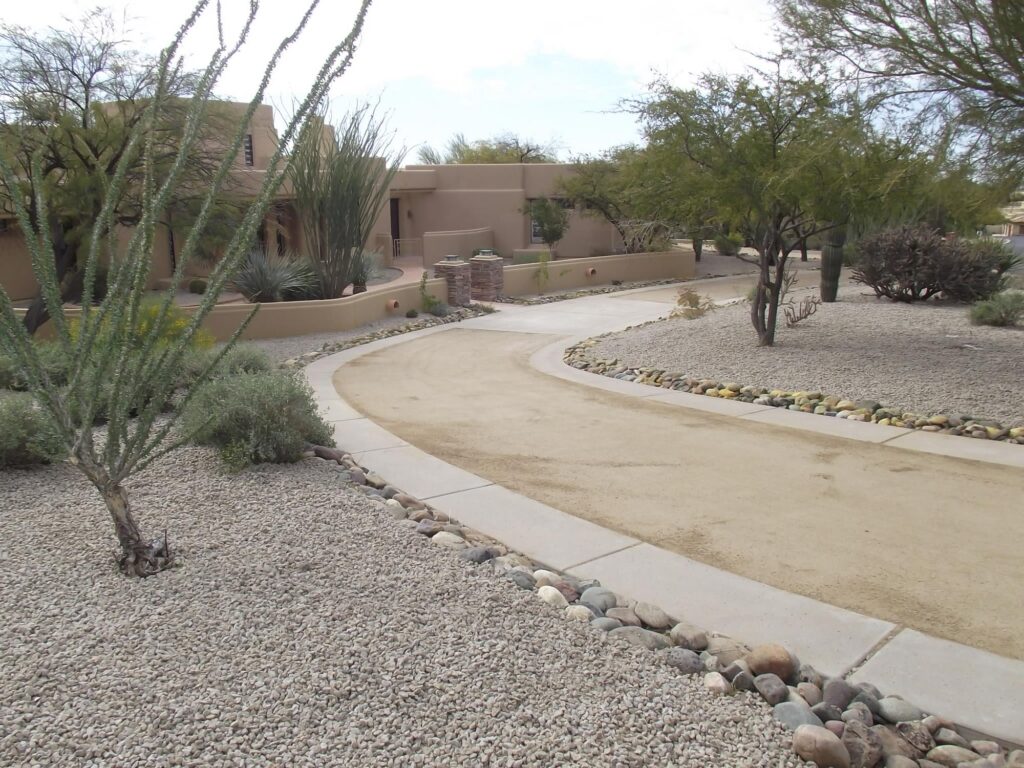
Two of the most common rocks we place in Arizona do almost opposite jobs. Decorative granite makes a yard look finished. Riprap keeps a slope from washing into the street. People often ask for one when they actually need the other, so here is a straight comparison of riprap vs. decorative granite: what each is built for, and how to tell which your property needs.
What decorative granite is
Decorative granite is screened, angular stone in warm desert colors, browns, reds, golds, and grays, usually sized from about half an inch up to an inch. It is the ground cover you picture on a Phoenix front yard: a clean, even layer over a weed barrier that pulls the whole landscape together. Because the pieces are small and angular, they lock into a tidy surface that is easy to rake, comfortable to walk near, and simple to plant into. You can browse decorative granite colors to see the range.
It is the right call for yard beds, HOA common areas, the ground around trees and shrubs, and anywhere the main job is looks and coverage.
What riprap is
Riprap is large, rough, angular rock, commonly in the three-to-eight-inch range, and six-to-twelve-inch for heavier work. Its entire purpose is to stay put when water moves. The size and weight are the point. Stones big enough that a monsoon cannot carry them armor the ground underneath against erosion. See the riprap and river rock options for the grades we carry.
You will find it on slopes, in drainage channels and washes, around culverts and downspouts, along retention basins, and lining dry riverbeds. It shows up constantly on commercial and municipal sites for exactly that reason.
The rough faces matter as much as the size. Angular riprap wedges against its neighbors and interlocks, while rounded rock of the same weight can still roll. On a serious slope, that interlock is the whole reason the hillside stays where it is.
Function vs. looks, side by side
| Decorative granite | Riprap | |
|---|---|---|
| Main job | Ground cover, finished look | Erosion and drainage control |
| Typical size | About 1/2″ to 1″ | About 3″ to 8″, up to 6″ to 12″ |
| Where it shines | Yards, common areas, around plants | Slopes, washes, basins, downspouts |
| Walkable? | Yes | No, uneven and sharp underfoot |
| Where it fails | Washes out on a steep grade or in a channel | Overkill and uncomfortable as yard cover |
The table makes the tradeoff plain. Put decorative granite in a drainage path and the next monsoon relocates it downhill. Spread riprap across a front yard and you get a lot nobody wants to walk on.
When you actually need both
Plenty of Arizona properties use the two together, and that is often the smartest layout. The classic example is a dry riverbed: a channel of riprap or river rock to carry monsoon runoff, bordered by decorative granite ground cover so the whole feature looks intentional instead of industrial. On a sloped lot, riprap armors the grade and the swale while decorative granite covers the flatter beds above it. You can see the full materials lineup to picture how they pair.
The guiding question is simple. Is this spot about moving or holding water, or about looking good and covering soil? Water gets riprap. Everything else gets decorative granite.
Sizing and placement make or break it
With both rocks, the detail that separates a job that lasts from one that fails is matching the stone to the forces on it. For decorative granite, that mostly comes down to depth and color. A full two inches hides the soil and holds weeds down, and matching the existing color keeps a refresh from looking like a repair. For riprap, it means picking a stone heavy enough for the water it will actually see, then seating it on graded, compacted ground so it does not shift. Drop big rock onto loose dirt and it looks like erosion control for one season, then slides.
Where one rock hands off to the other deserves a thought too. A dry riverbed that dumps straight onto fine decorative granite will scour it out at the outlet. A short apron of riprap or larger stone at the end of a channel spreads the flow before it reaches the finer ground cover. Small transitions like that are what keep an Arizona yard intact through a decade of monsoons.
A mistake that costs you every summer
The most expensive error we fix is decorative granite used where water runs. It looks great on install day in April, then the first real storm in July carves a channel through it and piles it at the bottom of the slope. Homeowners assume they bought bad rock. They did not. They bought the right rock for the wrong job. If an area moved gravel last monsoon, that is the area that needs larger stone, not another load of the same size. We wrote more about that in our guide to fixing monsoon washout.
Frequently asked questions
Can I use river rock instead of riprap for drainage?
Sometimes. Smooth river rock works in gentle channels and decorative dry beds, but on a steep grade or a hard-flowing wash, angular riprap locks together and holds better. The steeper and faster the water, the bigger and more angular the stone should be.
What size riprap do I need?
It depends on the slope and how much water crosses it. Gentle swales and downspout splash zones often do fine with three-to-eight-inch stone, while steep banks and real drainage channels call for six-to-twelve-inch or larger. A quick site look is the honest way to size it.
Is decorative granite ever wrong for a yard?
Only where water concentrates: the bottom of a slope, a drainage path, around a downspout. Everywhere else it is usually the right choice. For the trouble spots, switch to riprap and keep the decorative granite for the rest.
Not sure which your property needs, or where one should hand off to the other? That is exactly what a free on-site estimate sorts out. We supply and place both across Arizona, from a single backyard swale to a municipal drainage project. Reach out for a free estimate or call (602) 905-7099.