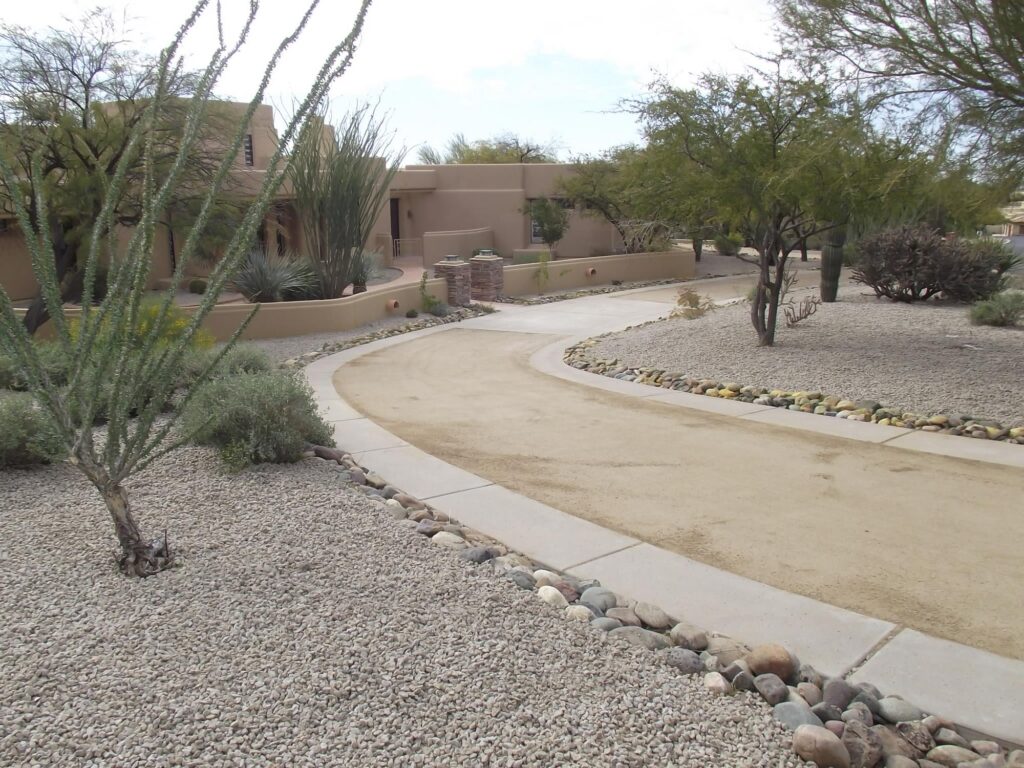
If you’ve started shopping for landscape rock in Arizona, you’ve almost certainly run into two names that sound alike but behave very differently: decomposed granite and decorative granite. They’re both crushed stone, they both suit our desert climate, and they’re often used just feet apart in the same yard, but choosing the wrong one for a given area leads to a surface that never quite works the way you hoped. Here’s a plain-English breakdown so you can pick with confidence.
What is decomposed granite?
Decomposed granite, usually shortened to “DG”, is granite that has weathered down into a mix of small pebbles and fine, sand-like particles. Because it contains those fines, DG can be raked smooth and compacted into a firm, stable surface. Colors tend toward natural desert tones: tans, browns, and soft golds.
That ability to pack down is DG’s superpower. When it’s installed and tamped properly, it forms a surface solid enough to walk, bike, and even set patio furniture on, while still draining water and looking soft and natural. You’ll see it used for:
- Pathways and walking trails
- Xeriscape and low-water garden beds
- Natural-looking patios and seating areas
- Dog runs and side yards
- Fill between pavers and stepping stones
You can explore the tones we carry on our decomposed granite materials page.
What is decorative granite?
It’s crushed and screened stone sold in consistent, chunkier sizes, commonly around a half-inch to three-quarters of an inch. The fines are screened out, so it does not pack down; it stays loose, letting water pass straight through. It comes in a much wider range of colors, from desert browns and golds to grays, blacks, reds, and blends.
Because it stays loose and drains freely, decorative granite is the go-to for ground cover: the classic “rock yard” look across most Arizona front and back yards, HOA common areas, and commercial properties. You’ll see it used for:
- Front- and back-yard ground cover
- Planting beds and around trees and shrubs
- Drainage areas and swales
- HOA greenbelts and streetscapes
- Anywhere you want lasting color and a clean, finished look
Our full color range lives on the decorative granite page, with 25-plus options to match almost any home or community palette.
Decomposed granite vs. decorative granite: the key differences
The short version comes down to how the two behave underfoot and over time:
- Compaction: DG packs into a firm surface; decorative granite stays loose.
- Best use: DG for surfaces you walk or sit on; decorative granite for ground cover and beds.
- Drainage: Both drain, but the looser rock lets water through fastest.
- Feel: DG is firm and smooth; decorative granite is loose and crunchy.
- Color range: DG leans natural and earthy; decorative granite offers far more color choice.
- Maintenance: DG paths may need occasional re-tamping and topping; decorative granite beds need periodic replenishment as they thin and fade.
Which one is right for your project?
For most Arizona yards, the answer is “both”, decorative granite as the ground cover across beds and open areas, with decomposed granite reserved for the paths, seating nooks, and side yards you actually walk on. A backyard might use a warm decorative rock around the planting beds and a compacted DG trail winding through it.
If your project is purely ground cover, refreshing a front yard, filling HOA common areas, dressing up a commercial frontage, it’s almost always the pick. If you’re building a walkable, natural surface, DG earns its keep. And if you’re starting a yard from scratch, our team walks you through the whole plan during a new rock installation, including grading and weed barrier so whichever material you choose performs for years.
Still deciding between colors and sizes? Browse everything we stock on the main materials page, or tell us about your space and we’ll recommend the right combination.
Frequently asked questions
Is decomposed granite good for Arizona backyards?
Yes, especially for pathways, patios, dog runs, and xeriscape areas where you want a firm, natural surface. For open ground cover, most homeowners pair it with decorative granite.
Does decorative granite wash away in monsoon storms?
Loose rock can migrate in heavy runoff, particularly on slopes. Proper depth, grading, and edging keep it in place; in high-flow spots we may recommend a coarser material or riprap.
Can I put decomposed granite over my existing rock?
It’s usually best to install DG on prepared ground so it can compact correctly. If you’re converting an area, we’ll assess what’s there and prep it properly first.
Not sure which to choose? We’ll help.
Picking the right material is half the battle, and it’s exactly the kind of thing we do every day across Arizona. Reach out for a free estimate and we’ll help you match the right rock, and the right color, to every part of your property.