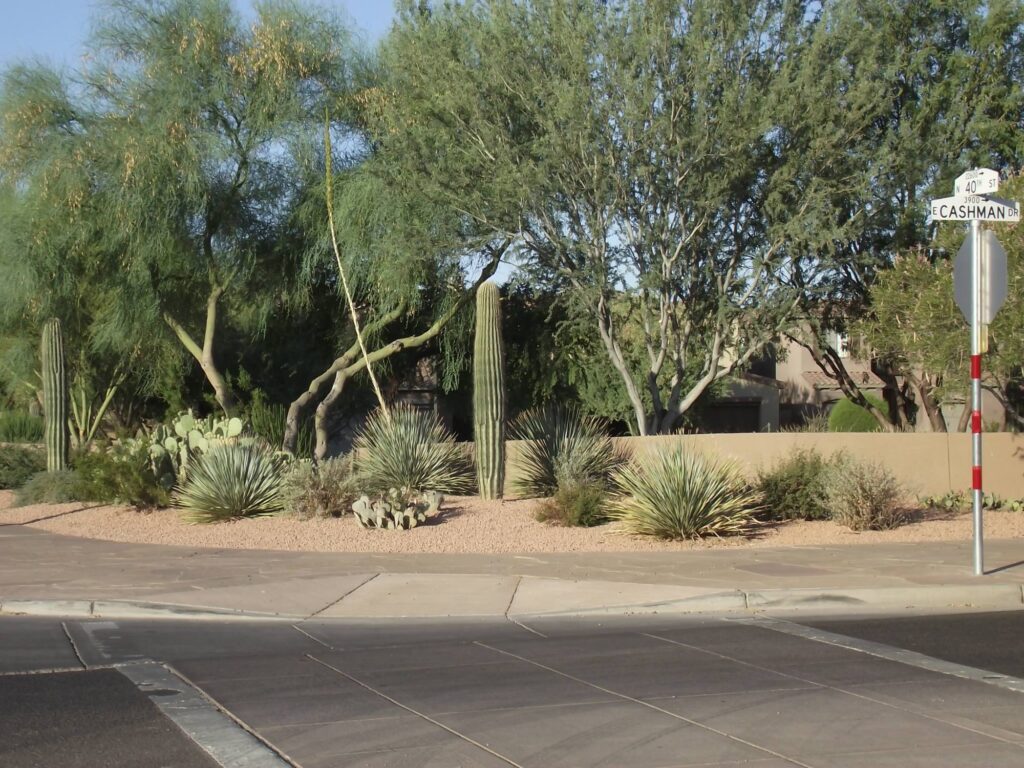
The landscape rock around a commercial property does quiet work. Customers never mention it when it looks right, but they notice the moment the entrance is bare, the parking islands are washing out, and the retention basin is full of weeds. For property managers across Arizona, a planned rock maintenance schedule is what keeps a site looking handled instead of neglected. And it costs far less than a scramble after the complaints start.
Here is how to build a year-round plan that keeps commercial common areas sharp.
First impressions live in the rock
On most commercial and municipal sites, gravel covers more ground than anything else: entrances and monument signs, parking-lot islands, medians, walkways, retention basins, and the strips along the building. When that rock is deep, even, and clean, the whole property reads as well-run. When it is thin and patchy, it drags down everything around it, no matter how good the building looks. It is the biggest surface on the site and the easiest one to let slide. Our commercial and municipal work is built around keeping that surface right.
Scheduled beats reactive
The expensive way to maintain a property is to wait for a board member or a tenant to complain, then rush a fix. The cheaper, calmer way is a set rotation. Most commercial and HOA common areas hold up well on a two-to-four-year replenishment cycle, with the high-traffic and high-visibility zones refreshed sooner. For the full picture on timing, see how often landscape rock needs replenishing. Putting that on a calendar does two things. The property never hits the bare, washed-out stage, and the cost becomes a predictable line item instead of an emergency.
Predictable is a lot easier to budget than urgent.
Know which zones wear first
Not every part of a property ages at the same rate, so a smart plan treats them differently instead of doing everything at once.
- Entrances and monument signs carry the first impression and the most eyes. Keep these the freshest.
- Parking islands and medians take sun, foot traffic, and car doors, and they thin fast.
- Retention basins and drainage swales move water every monsoon and need larger stone, not decorative gravel. That is a job for riprap.
- Building-edge strips and back-of-house areas can usually wait longer, which frees budget for the visible zones.
Mapping a property this way lets you spend where it shows and stretch the areas that do not.
Arizona’s calendar drives the timing
The desert sets the schedule. Monsoon season from June into September moves gravel and carves drainage every year, so the natural time to assess and refresh is early fall once the storms stop. That also lands the work right before the winter-visitor season, when retail centers, resorts, and snowbird communities see their heaviest traffic. The same early-fall timing works for HOA communities, and our playbook for keeping HOA common areas sharp year-round breaks it down season by season. For portfolios spread across the Valley, we coordinate the work by site so everything is current heading into the busy months. You can see where we work on our service area page.
The cheap-bid trap
The lowest number on a quote usually hides something. Rock spread too thin looks fine for a month, then the soil shows through and the weeds return, and you are paying again inside a year. Unmatched material leaves a patchwork of colors across a property that is supposed to look uniform. A proper job means the right depth, a full two to three inches, matched rock, and real attention to the drainage areas that actually fail. It costs a little more up front and far less over the life of the property.
We have replenished more rock than anyone in Arizona, which means we have also seen what the shortcuts cost two years down the road.
What a site walk turns up
A good plan starts with someone actually walking the property, not pricing it off a map. On a site walk we look at the things that decide the schedule: how deep the rock still is in each zone, where the color has gone flat with dust, which drainage areas moved this monsoon, and whether the material on the ground can even be matched or whether a section has drifted into a mix of sizes. Those findings are what turn a vague maintenance budget into a real rotation with dates on it.
For municipal and right-of-way work, the same thinking applies at a larger scale. Medians, roadside slopes, and basins take the brunt of both traffic and storm flow, so they tend to run on a tighter cycle and lean on larger stone than a retail island does. We size and schedule those separately rather than treating the whole site as one job. The point of the walk is simple: fix what shows, plan what is coming, and skip what can wait.
Frequently asked questions
How often should a commercial property refresh its landscape rock?
Most commercial and HOA common areas do well on a two-to-four-year replenishment cycle, with entrances and high-traffic zones refreshed sooner. The real trigger is visual: once soil shows through or the color dulls with dust, it is due.
Can you handle multiple properties on one schedule?
Yes. For managers with several sites, we coordinate replenishment across the portfolio so every location stays current and the work is easy to budget and plan around the seasons.
Do you work with municipalities and large commercial sites?
We do. Along with HOAs and commercial centers, we supply and place rock for municipal projects across Arizona, including the drainage and erosion-control work that calls for riprap.
If you manage a property or a portfolio and you are tired of chasing complaints, the fix is a plan, not another emergency call. We will walk the site, map the zones, and lay out a replenishment schedule that keeps everything sharp year-round. Request a free estimate or call (602) 905-7099 to get started.